Home

Kriterion is a Python library for analysing data using signal detection theory.
Key features:
- Compute sensitivity and bias measures: \(d'\), \(c\) and more
- Fit detection models to ROC data
- Assess model fits
Installation
It is recommend to use a virtual environment when installing python packages (see here). Then:
Dependencies
- NumPy
- SciPy
Usage
Example 1: Basic signal detection theory measures
With a single true positive and false positive rate, return all common detection measures:
from kriterion.measures import compute_performance


result = compute_performance(tpr=0.75, fpr=0.21)
print(result)
Out
Performance(
    tpr=0.75,
    fpr=0.21,
    d_prime=1.480910997214322,
    a_prime=0.850886075949367,
    c_bias=0.06596574841107933,
    beta=1.1026202605581668,
    a_z=None
)
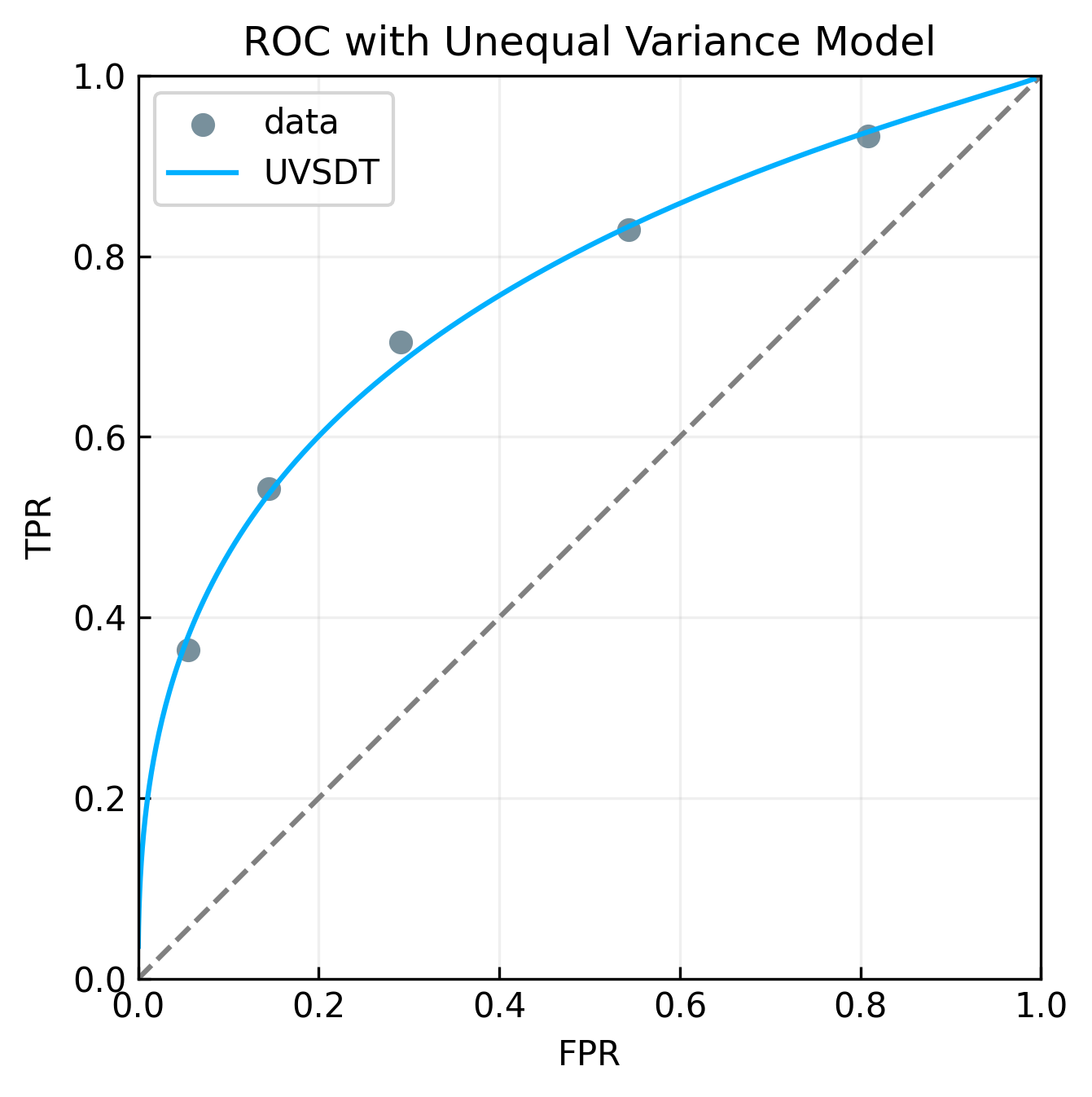
Example 2: Receiver operating characteristic (ROC) modelling
Given a set of rating-scale responses to signal and noise trials:
from kriterion.data import ROCData
from kriterion.fit import fit
from kriterion.models import  UnequalSignalDetection


data = ROCData(
    # Strongest "signal" <---> Strongest "noise"
    # All responses to signal-present trials
    signal=[505, 248, 226, 172, 144, 93],
    # All responses to signal-absent (i.e. noise) trials
    noise=[115, 185, 304, 523, 551, 397],
)

uvsdt = UnequalSignalDetection(data)

result = fit(uvsdt)
Out
print(uvsdt.parameters)
{
    'd': 1.1830254066861041,
    'signal_sd': 1.337287925732202,
    'c0': 1.0405303717702958,
    'c1': 0.46634923592441596,
    'c2': -0.06932116955166004,
    'c3': -0.6973808897916125,
    'c4': -1.4561271120010804
}

print(result)
ModelSummary(
    dof=3,
    chi2=9.183606301259807,
    chi2_p=0.02694676677704899,
    g2=9.305614752213955,
    g2_p=0.02549179488508846,
    log_likelihood=-5761.067476662813,
    aic=11536.134953325625,
    bic=11579.184187136441,
    sse=0.0004422615018773785
)
License
This project is licensed under the terms of the GPL-3.0 license.